This approach was developed at Case Western University by David Cooperrider, Frank Barrett and Suresh Srivistra. In contrast with the traditional problem solving approach that looks to analyse what is going wrong, Appreciative Inquiry seeks to identify what works in organisations, and to construct future propositions based on the best of what we do. By grounding the propositions of the future in concrete experience, people find it easier to relate to and to commit their energies.
The approach emerges from a real consulting project that David and Frank were conducting with the Cleveland Clinic in 1980. Caught in a spiral of deficit thinking, blame, threat and impending doom, the staff felt helpless and hopeless. Trying to help them break out of this spiral, they were asked to investigate success factors in other locations, and soon discovered that they were looking for sources of strength and success in their own location.
Ken Gergen’s work in the area of social construction theory in 1982 added to the theoretical underpinning of AI, which also draws on research in a number of different fields. We know that if we think positively, then positive things happen. e.g. the Pygmalion Effect, where the belief of the classroom teacher regarding the ability if the pupil is reflected in practice; and the placebo phenomenon where between one-third and two-thirds of all patients will show marked signs of physiological and emotional improvement through the belief in the treatment, even if that is only a sugar pill.
It has also been shown that a double negative does not have the same effect as a clear positive image. For example, in golf telling yourself not to hit it into the woods actually focuses the mind on ‘the woods’ and the ball travels there with unnerving accuracy.
But Appreciative Inquiry is not just ‘positive thinking’. It is an inquiry process that is grounded in reality by focusing on successful examples in the past and present. Through structured conversation we build a picture of the themes and ideas that we know we can do, and that work. It is a definite shift from our traditions of education, training and institutions where the concentration is on what is wrong.
| Problem solving | Appreciative Inquiry |
| Basic assumption:Organising is a problem to be solved | Basic assumption:Organising is a solution to be celebrated and built on |
| Focus on what is wrong | Appreciates the best of ‘what is’ |
| Searches for causes | Develops possibilities |
| Designs solutions to put things right | Creates a vision that expands on the best |
| Outcome:Incremental improvement | Outcome:Breakthrough improvement |
Appreciative Inquiry is based on dialogue. The first step is to collect opinions and observations of everyone involved through telling stories of what has been and is successful. These observations are then shared in a workshop format to identify the themes and topics that run through the stories. Finally, a selection of the most important of these themes forms the basis for building a series of provocative proposition that describes how the organisation will be.
The 5D’s of Appreciative Inquiry
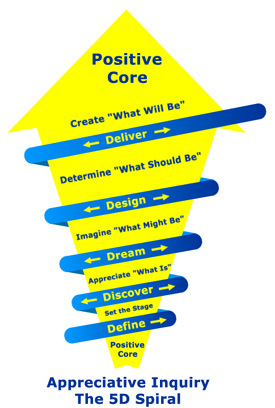
The Strength of Collective Imagination
Problem solving as a process for inspiring and sustaining human system change is limited. Deficit analysis, powerful in diagnosis, often undermines human organising, because it is likely to create a sense of threat, separation, defensiveness and deference to expert hierarchies.
Words Create Worlds: Words can both destroy or heal. The words we choose directly influence the dynamics of our conversations… Consider the power of words like hope, imagination, community, transformation, relationship, connection, integrity, learning, spirit, generosity, vision, creativity, value, possibility… How do you use language? How do you normally describe things? Is your language inspiring?
Questions Determine Outcomes: The act of asking a question influences the person, group or community. If you inquire into problems, people will focus on what is wrong. If you inquire into what is going well, you will discover best practices on which you can build. People, groups and communities will grow in the direction of their inquiry.
Positive Images Inspire Positive Actions: Students identified as high potential perform better. If you expect to get well, you are more likely to do so. Coaching good performance leads to more positive outcomes than highlighting errors. It is important to say what we DO want.
Stories have Power and Energy: People organise experiences in stories. Individual, team, company and community identities are socially constructed through the exchange of stories. No one story defines a person, team or organisation – all are multi-storied creations.
Structures are needed to Encourage Visionary Dialogue and Thinking: People are amazing and gifted at envisioning and creating the future is they have a proper forum and encouragement to do so. Since much public discourse is deficit-based and problem oriented, we must construct forums to develop affirmative competence, creative agency and collective dreaming. People will move naturally toward a picture of the future they have imagined and created together
Change management methods that evoke stories, and affirm and compel groups of people to envision an image o the future grounded in the best from the past, have the greatest potential to produce deep and sustaining change.
A key to the emerging paradigm
| Scientific paradigm | Emerging paradigm |
| Newtonian mathematics; reductionist and dichotomous thinking | Quantum physics and new sciences;; self organising systems; chaos theory; complexity theory |
| We search for a model or method of objectively perceiving the world | We accept the complexity and subjectivity of the world |
| We engage in complex planning for a world we expect to be predictable | Planning is understood to be a process of consistent re-evaluation |
| Language as a descriptor of reality: “I’ll believe it when I see it” | Language as the creator of reality: “I’ll see it when I believe it” |
| Information as power | Information as a primal creative force |
| Things can be best understood when they are broken into parts | Wholeness and interconnectedness of all things |
| Dichotomous thinking | Search for harmony and common threads of dialogue |
| There is one truth for which we must search | Truth is dependent on the context and reality |
| Influence occurs as a direct result of force exerted from one person to another: cause and effect | Influence occurs as a natural part of human interaction |
| The world is linear and hierarchical | It is a circular world of relationships and co-operation |
Where Appreciative Inquiry has been used:
| Community Development | Strategic Planning & Visioning |
| Customer Service | Supply Chain Management |
| Process Improvement | Culture Change and Transformation |
| Change Leader Development | Innovation and Creativity |
| Diversity Programmes | Performance Management |
| Training Design and Delivery | Collaborative Networks |
| Dialogue | Corporate Social Responsibility |
| Spirituality in the Workplace | Capacity Building |
| Leadership Development | Sustainability |
| Marketing & Branding | Mergers & Partnerships |
| Whole Systems Change | Organisational Design |
| Knowledge Management | Mentoring |
| Cross Cultural Communication | Rewards/Recognition Systems |
| Team Development | Conflict Transformation |
| Partnerships and Alliances | Social Action |
| School Reform | International Development |
| Executive Coaching | Management Education |
Real Time Rapid Change Case Studies using AI:
Dundee City Council
Situation: Facilitating culture change in a Social Work Department to address a crisis in recruitment and retention of qualified workers.
Action: Following a research project, 9 pilot teams were established to investigate the potential for flexible working in terms of location and/or hours. These pilots were established using AI methodology to enable the maximum participation and freedom of action, identifying the factors that underpinned success in managing work and other priorities for them. Teams developed their own priorities and processes based on their past experience, free from organisational constraint. Simultaneously a series of workshops for senior and first line managers identified the underpinning organisation culture change necessary and developed a behaviour competence model, using AI to identify the behaviours associated with success.
Results: An evaluation of the flexible working pilots demonstrated financial savings as well as major improvements in staff utilisation and satisfaction, plus improved client response, and the system is being extended to all staff. The behaviour competence model has been confirmed and adopted by the department as part of their performance management process.
Albyn Housing
Situation: Faced with a growing level of disputes, a Housing Association wanted to review and develop its HR strategy.
Action: A whole organisation inquiry was conducted using internal staff trained in AI interviewing to gather data on peak performance practice. A 2 day Summit of representatives from every level of the organisation was held to review this data in the light of the topic “Our staff delivering our business plan.” The Summit identified key themes that underpinned the success of staff engagement in the organisation and developed value statements that would guide the development of staff/organisation relationships. Action plans were drawn up to close any significant gaps from current practice.
Results: The final report was implemented in full. Staff disputes reduced, absenteeism and sickness levels dropped, productivity increased and the Association began to recover its position as an employer of choice in the area.
Bayer Pharmaceuticals
Situation: Developing a common working philosophy to deliver the corporate mission in a sales region of a multi-national pharmaceutical company.
Action: A half day workshop for the entire regional sales team was facilitated using AI to identify the participants’ best practices in working and develop a common vision for the team.
Results: A powerful image and vision statement was produced by the team. The Regional Sales Manager felt that more had been achieved in the half day than at previous two day workshops typified by ‘death by acetate!’ The methodology is being actively promoted throughout the organisation.
Scottish Enterprise
Situation: Identifying the strategic drivers for the economic future of Scotland.
Action: A diverse group of 150 people from across the spectrum of the Scottish economy— business, public and voluntary sector, academia, trade and professional bodies—met to engage in a dialogue about what works for them
Results: The success of the dialogue process led to the creation of a continuing dialogue through a web-site. The outcomes were integrated into the core ‘Scotland’s Future’ strategy formulated by Scottish Enterprise and led to further work on using sustainable economic indicators and being a catalyst for the establishment of Imagine Scotland
Chartered Management Institute
Situation: A professional institute was addressing the issues of falling membership and involvement. A key group of people needed to be consulted and engaged in the change process
Action: As part of an conference for 200 officers, an AI process was run to focus attention on the benchmarks for success and creating an exciting future for members.
Results: The use of the approach at the conference avoided a potentially confrontational situation and instead achieved support, enthusiasm and a focus for change, motivating the Director General to introduce wider ranging changes than initially envisaged.
London Borough of Southwark
Situation: The planning department of a London borough wanted to get commitment to its strategic plan.
Action: A one day, total staff conference (95 people) was convened and run on AI lines to gather experiences from all staff on their successful working practices, translate these into a vision and set of working premises that would guide their practice when implementing the strategic plan. A high participation event enabled staff and management to generate ideas and action plans on an equal footing.
Results: The immediate impact was a much more engaged workforce, working across silos in the organisation to meet the needs of the community and strategic plan. Several working groups continued to pursue some improvement themes identified at the conference under the leadership of the Director.
Charter Community Housing
Situation: An organisation, newly formed as a spin-off from a local authority was seeking to establish its organisation vision and strategy.
Action: Two whole day large group events were convened using Appreciative Inquiry and Open Space to identify the underlying motivations and values of the organisation and to increase understanding of the organisation vision, mission and strategic aims
Results: The information gathered from the events provided significant strategic information on employee and customer drivers and priorities which were incorporated into operational and strategic plans. The whole workforce had met together for the first time and forged a new identity and enhanced communications.
Scottish Executive
Situation: Local Authorities, Housing support service suppliers and the Scottish Executive could not agree on wording for service contracts
Action: A series of large group dialogues were convened across Scotland to include all stakeholders to identify the elements of the service contracts that worked and those that were essential for success.
Results: The events provided the first areas of agreement between stakeholders who had been in discussion through other mediums for 18 months. The agreements formed the basis for further detailed negotiations in a positive atmosphere.
 Geof Cox